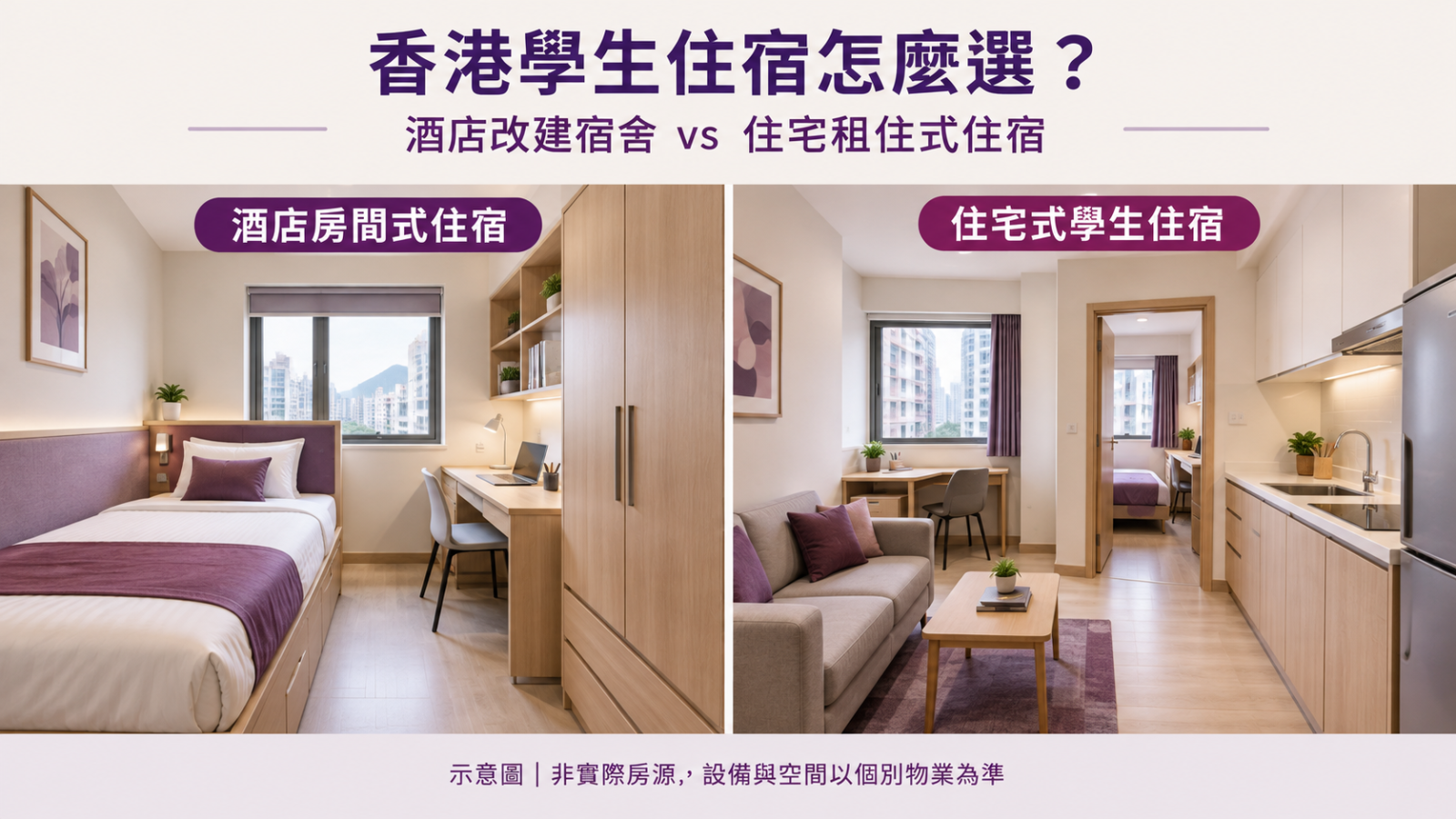
Hotel-converted student residences and apartment-based student rentals serve different needs. A hotel-converted residence generally operates within one building, while apartment-based accommodation allows students to compare whole-flat and shared-flat arrangements across available locations. The right choice depends on room configuration, total cost, commuting, everyday facilities and tenancy terms—not the headline rent alone.
Cheuk Ngai Group’s website describes student accommodation in multiple Hong Kong districts, whole-flat and shared-flat options, and one-to-one tenancy support. Students seeking a more residential living arrangement or accommodation with familiar classmates may wish to compare these options. Availability, equipment, charges and tenancy terms must be confirmed for the specific property.
How do the two accommodation models differ?
| Factor | Hotel-converted residence | Cheuk Ngai apartment-based accommodation |
|---|---|---|
| Location | Based at a particular building address. | Options across available districts; shortlist according to campus and budget. |
| Room and privacy | Single, twin or other configurations may be offered; verify bathrooms and shared facilities. | Compare private rooms in shared flats and whole-flat arrangements, subject to supply. |
| Cooking and laundry | Equipment and permitted use depend on the operator. | Check the kitchen, appliances, laundry equipment and house rules for the actual flat. |
| Fees | Some packages include specified utilities or services; check caps and extras. | Request a written breakdown of rent, utilities, internet, management and cleaning charges. |
| Support | Reception, security, maintenance and service hours vary. | The website describes one-to-one support; confirm its scope, hours and emergency arrangements. |
When might Cheuk Ngai’s rental model suit you?
1. You want to compare neighbourhoods, not just one building
The website lists service areas including Sai Ying Pun, Central and Sheung Wan, North Point, Prince Edward and Tai Wai. Students can start with their actual teaching campus, budget and acceptable commute before checking available properties. A listed service area does not mean a room is currently available.
2. You want a choice between a shared flat and a whole flat
A private room in a shared flat may suit an individual student, while a whole flat may be worth discussing with familiar classmates. Confirm who signs the lease, permitted occupancy, roommate arrangements, payment responsibilities and early termination terms. A whole-flat tenancy does not automatically permit subletting.
3. Everyday residential facilities matter to you
If you cook regularly, attend online classes at home or need storage, check the kitchen, fridge capacity, laundry arrangements and usable space. The benefit is the ability to compare real residential layouts—not a guarantee that every flat has the same facilities or unrestricted use.
4. You value a named tenancy contact
Cheuk Ngai’s website describes one-to-one support and online enquiries. Students who have not arrived can ask about current photos, videos and viewing arrangements. Remote viewings do not replace verification of the property, contracting party and payment details. Support should not be assumed to include round-the-clock response or free repairs unless expressly agreed.
Practical considerations for mainland students and their families
Students have different habits and priorities. Rather than assuming everyone wants the same lifestyle, use the following questions to identify your own requirements.
- Cooking: What equipment is provided, and what are the cleaning and use rules?
- Privacy and study: How many people share the flat, and what are the visitor and quiet-hour rules?
- Family reassurance: Who lets the property, signs the agreement, receives payments and handles repairs?
- Remote arrangements: Can you obtain recent footage, clear property details and written terms?
- Budget: What is the total cost over the agreed tenancy, not just the advertised starting rent?
- Commuting: Does the route work for your actual campus and class times?
Compare total costs and upfront cash separately
List recurring rent and charges, usage-based utilities, transport and any one-off expenses. Record refundable deposits separately from accommodation costs, while accounting for the cash needed upfront. Without comparable written quotations for similar locations, dates and occupancy, it is not reasonable to say that shared apartments are always cheaper than hotel-converted residences.
When might a hotel-converted residence be preferable?
A hotel-converted residence may suit students who prioritise a private room, centralised management or on-site study and social facilities, provided the location, price and rules fit their needs. Those facilities and services are property-specific rather than guaranteed features of every hotel-converted residence.
Seven checks before signing
- Confirm whether you are renting a bed, private room or whole flat.
- Verify the address, layout, shared occupancy and current condition.
- Check the letting, contracting and payment parties; retain written records.
- Obtain a complete breakdown of rent, deposits, advance payments and extras.
- Read the tenancy duration, early termination, renewal and deposit return terms.
- Confirm repair responsibilities, reporting procedures and emergency contacts.
- Record the condition, equipment and applicable meter readings at move-in.
Enquiring about Cheuk Ngai accommodation
Provide your university and teaching campus, move-in date, tenancy length, total monthly budget, number of occupants and preference for a whole or shared flat. Include essential requirements such as cooking facilities, laundry or a private bathroom. Compare the actual offers and tenancy terms before deciding.
View student accommodation information | Read tenancy FAQs
Sources and further reading
- Cheuk Ngai Group: student accommodation
- Cheuk Ngai Group: tenancy FAQs
- Study in Hong Kong: accommodation information
- CBRE: hotel and residential student accommodation analysis
This guide is not legal advice, a property quotation or a service guarantee. Current availability, facilities, charges and tenancy arrangements are subject to written confirmation and the tenancy agreement.