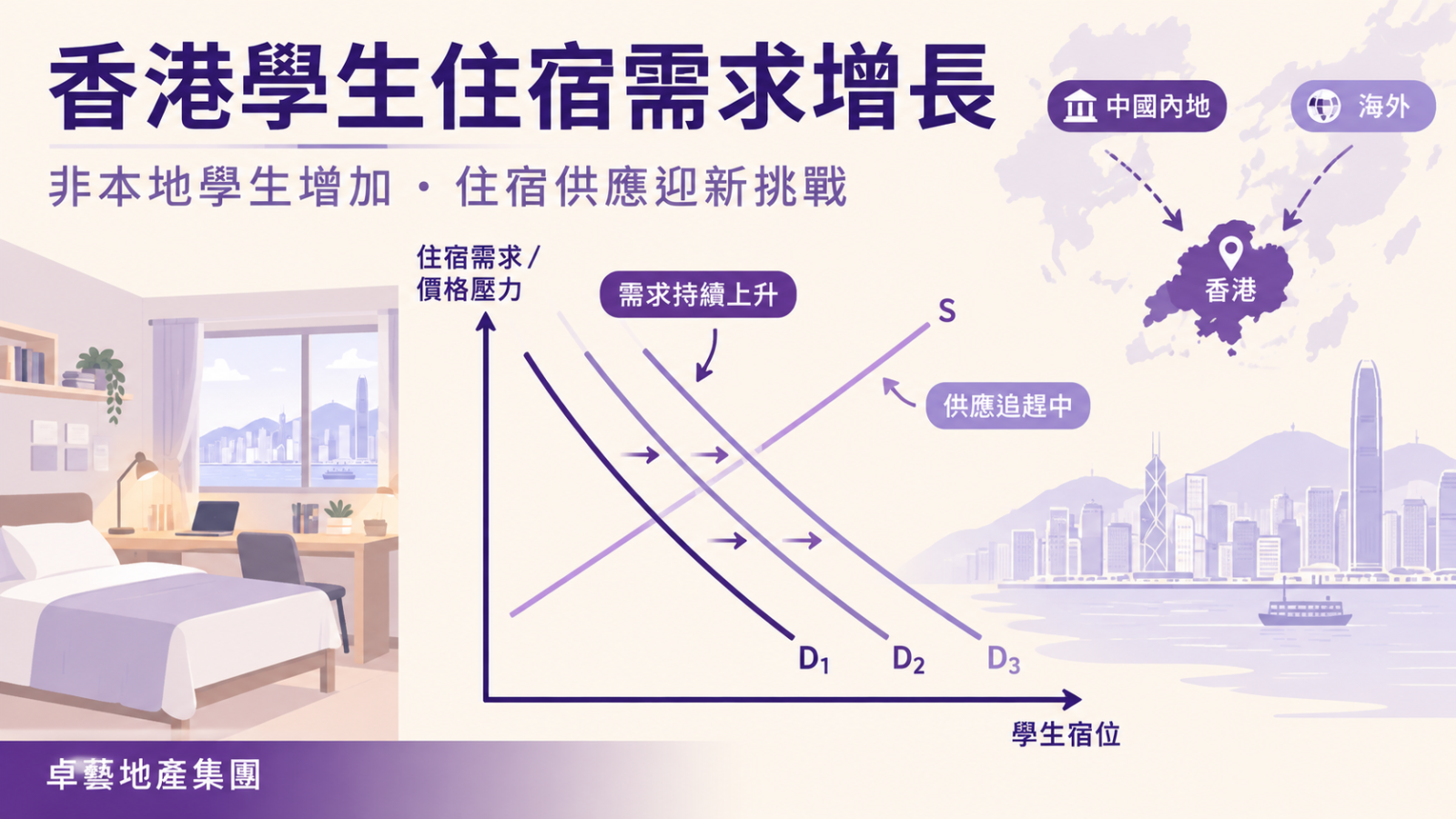
Hong Kong’s first Five-Year Plan, published on 16 September 2026, sets an expected target to increase the number of non-local students enrolled in locally accredited full-time post-secondary programmes from 79,800 in the 2024/25 academic year to 100,000 by 2029/30. The difference is approximately 20,200 students, representing cumulative growth of about 25%. This is a planning target, not the admission quota for the 2026/27 academic year.
How could student accommodation demand change?
As a simple scenario, if every additional non-local student required one bed in Hong Kong, the increase in student numbers could imply demand for approximately 20,200 additional beds by 2029/30. This is an illustrative assumption, not an official forecast of bed demand. Some students may live with family or rent independently, while some existing students already depend on accommodation in the private market.
The wider accommodation market also includes demand from local and continuing students. According to estimates published by JLL in 2026, total student accommodation demand in Hong Kong was approximately 128,300 beds in the 2025/26 academic year, compared with around 52,000 beds supplied by universities and the existing private market. That implies a gap of approximately 76,300 beds. Based on JLL’s forecast of foreseeable demand and supply, demand could rise to about 223,800 beds by 2029/30, against supply of approximately 76,600 beds, leaving a potential gap of around 147,200 beds.
These figures should not be added together. The Government’s target of 100,000 refers to non-local post-secondary students within a defined category. JLL’s accommodation estimates cover demand from both local and non-local students. The increase of approximately 20,200 people describes growth in the Government’s student target; the potential gap of 147,200 beds is a separate market forecast for overall accommodation supply and demand in 2029/30.
Existing and planned hostel supply
The Government is encouraging property conversion and redevelopment for student accommodation through the Hostels in the City Scheme. The 2026 Policy Address states that 41 applications had been confirmed as eligible at the time of publication, involving approximately 10,800 beds. The Government also plans to tender its first student hostel site during the current financial year. These measures could expand future supply, but eligibility confirmation does not mean that all 10,800 beds have been completed, opened for booking or become available for immediate occupation.
Students, parents and recruitment organisations should therefore distinguish between beds available now, eligible projects still being developed, and new hostels yet to be built. Treating planned supply as immediately available may understate the pressure of arranging accommodation before the academic year begins.
How can Cheuk Ngai Group support students?
Private student accommodation can offer another option for students who cannot secure an institutional hostel place. According to Cheuk Ngai Group’s published service descriptions, it offers rental accommodation for students studying in Hong Kong, with options across Hong Kong Island, Kowloon and the New Territories, including whole-unit and shared accommodation. Actual availability, locations, rents and tenancy terms should be confirmed at the time of enquiry.
- More accommodation options: Private student accommodation gives students another type of housing to compare when on-campus places are limited.
- Different budget arrangements: Whole-unit and shared accommodation allow students to compare living arrangements and ways of sharing rental costs according to their budget and privacy needs.
- Choice of location: Options across different parts of Hong Kong allow students to compare commuting times, transport costs and neighbourhood convenience in relation to their campus.
- Earlier move-in planning: After receiving an offer of admission, incoming students can enquire about available units, tenancy periods, deposits, charges and move-in documents before the start of term.
Whether a professional accommodation service reduces rental risk depends on the specific property and service terms. Before signing, students should confirm the actual room and number of occupants, what the rent includes, deposit and termination terms, maintenance responsibilities, management arrangements and emergency contacts. Where the resident is underage, guardianship, supervision and safety arrangements require additional checks.
Conclusion
Growth in the target number of non-local post-secondary students creates opportunities for Hong Kong’s education and accommodation sectors, but a higher student target does not automatically create beds that are ready to occupy. The Government, institutions and private operators will need to expand accommodation that is genuinely available, has clear terms and meets students’ needs. Cheuk Ngai Group’s whole-unit and shared accommodation services can form part of the options students consider beyond institutional hostels; each decision should still be based on actual availability, budget and tenancy terms.